Home Blog Accounting in the UAE (2026): VAT, Corporate Tax & IFRS

Accounting in the UAE in 2026: bookkeeping, VAT, Corporate Tax, free zones and audit

Jul 14, 2026
32 min
6
Jul 14, 2026 20:16
Accounting in the UAE in 2026: bookkeeping, VAT, Corporate Tax, free zones and audit

Accounting in the UAE in 2026: bookkeeping, VAT, Corporate Tax, free zones and audit

Accounting in the UAE is no longer a back-office formality. The figures in your books determine Corporate Tax, support VAT returns, help preserve free zone tax treatment, and shape how banks, auditors and investors assess the business. This guide explains what a compliant accounting system should contain in 2026, which thresholds and deadlines matter, and where free zone, audit, payroll and AML rules require additional attention.

Last reviewed: 14 July 2026. This guide was checked against official materials published by the UAE Federal Tax Authority, Ministry of Finance, Ministry of Economy and Tourism, and Ministry of Human Resources and Emiratisation. Because the correct treatment depends on the facts of each business, a named UAE-qualified tax or accounting professional should complete the final professional review before publication.


Key takeaways

  • Most operating UAE companies need reliable accounting records even when they are below the VAT threshold or expect to pay little or no Corporate Tax.
  • VAT and Corporate Tax are separate regimes. Registration for one does not replace registration, filing or payment obligations under the other.
  • For UAE-resident businesses, mandatory VAT registration generally starts at AED 375,000 of taxable supplies and imports; voluntary registration may generally be available from AED 187,500.
  • For most taxable persons, the standard Corporate Tax rates are 0% on taxable income up to AED 375,000 and 9% on taxable income above that amount, subject to the detailed rules and any applicable special regime.
  • A free zone licence does not automatically guarantee a 0% Corporate Tax rate. A Qualifying Free Zone Person must satisfy the relevant conditions, maintain adequate substance and records, and prepare audited financial statements.
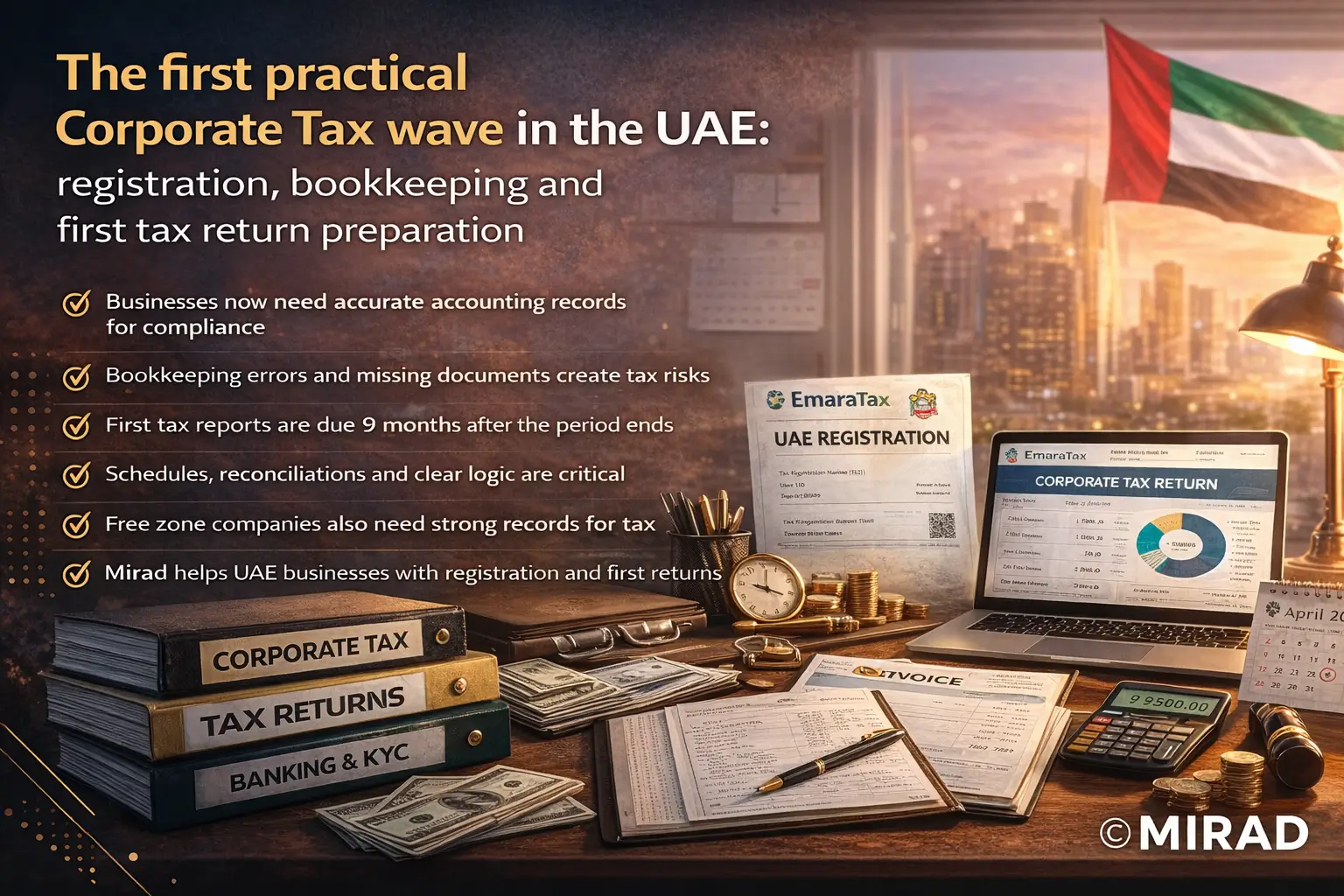
  • Corporate Tax returns and payment are generally due within nine months after the end of the tax period. Corporate Tax records must generally be retained for at least seven years.
  • Economic Substance Regulation reporting was cancelled for financial years ending after 31 December 2022. ESR should therefore be treated as a historical-period issue, not as a routine 2026 filing obligation.

In this guide


Why accounting matters in the UAE

A business can be below the VAT registration threshold and still need accounting. Corporate Tax is based on accounting income after the adjustments required by tax law, while banks, free zone authorities, investors and auditors may request financial information independently of VAT status. Without a complete ledger, the company cannot reliably explain its revenue, expenses, assets, liabilities, related-party balances or taxable position.

Good accounting also protects the business when its circumstances change. A company that begins with a small number of transactions may cross a VAT threshold, hire employees, open additional bank accounts, trade with related parties, enter a free zone qualifying activity or become subject to audit. Reconstructing several years of records after the event is usually slower, more expensive and less reliable than maintaining the books from the start.

The objective is not simply to produce a year-end profit figure. A dependable system should allow management and an external reviewer to trace each material balance from the financial statements back to the ledger, source document, bank movement and tax treatment.

What a compliant bookkeeping system includes

A compliant system is more than a spreadsheet of money received and paid. It should connect source documents, bank movements, accounting entries, tax treatment and management reporting so that each material balance can be traced and explained.

  • Chart of accounts: a structure suited to the company’s activity, tax profile and reporting needs.
  • Transaction recording: sales, purchases, expenses, payroll, fixed assets, loans, owner transactions and intercompany balances.
  • Document matching: invoices, contracts, receipts, customs records, payroll files and payment evidence linked to the relevant entries.
  • Bank and cash reconciliation: regular reconciliation of every bank account, payment gateway and cash balance.
  • Receivables and payables control: customer and supplier ageing, overdue balances, deposits and advances.
  • Fixed-asset register: acquisition cost, useful life, depreciation, disposals and supporting documents.
  • Tax ledgers: VAT output and input tax, Corporate Tax adjustments and supporting schedules.
  • Period-end close: accruals, prepayments, provisions, foreign-exchange revaluation and management review.
  • Financial reporting: statement of financial position, profit or loss, cash-flow information and supporting notes or schedules where required.
  • Controlled archive: an organised digital repository with access rights, backups and a document-retention policy.

IFRS, IFRS for SMEs and the cash basis

For Corporate Tax purposes, the UAE framework uses International Financial Reporting Standards (IFRS) or IFRS for SMEs as the applicable accounting standards. The accounting result is the starting point for taxable income, but it is not always the final tax result: tax legislation may require adjustments for exempt income, non-deductible expenses, related-party transactions, interest limitations, tax losses and other items.

The cash basis is available only in limited circumstances. Under the FTA guidance, a person with revenue not exceeding AED 3 million may prepare financial statements on a cash basis for Corporate Tax purposes, subject to the applicable rules. Once revenue exceeds the threshold, the business generally needs to move to accrual accounting unless an exceptional circumstance is accepted by the FTA.

Method or frameworkWhat it meansTypical relevance
Accrual basisIncome is recognised when earned and expenses when incurred, rather than only when cash moves.The normal basis for established businesses and IFRS reporting.
IFRS for SMEsA simplified financial-reporting framework for eligible entities.May be appropriate for qualifying smaller businesses, subject to the UAE Corporate Tax rules.
Cash basisRevenue and expenditure are recognised by reference to receipt and payment.Potentially available where revenue does not exceed AED 3 million, subject to the rules.

Practical point: “cash in the bank” is not the same as profit. Customer deposits, shareholder loans, VAT collected, loan repayments and transfers between company accounts all require the correct accounting treatment.


VAT accounting in the UAE

The UAE’s standard VAT rate is 5%. For UAE-resident businesses, mandatory registration generally applies when taxable supplies and imports exceeded AED 375,000 in the previous 12 months or are expected to exceed that amount in the next 30 days. Voluntary registration may generally be available when taxable supplies, imports or taxable expenses exceed AED 187,500. The mandatory threshold does not apply to foreign businesses in the same way, so non-resident cases require separate analysis. See the FTA VAT registration guidance.

After registration, VAT returns and the related payment are generally due within 28 days after the end of the VAT tax period. The filing frequency and tax period are assigned by the FTA, so the business should follow the dates shown in EmaraTax rather than assume that every registrant files on the same calendar.

What the VAT ledger should capture

  • The date of supply and tax point, not only the payment date.
  • Standard-rated, zero-rated, exempt and out-of-scope transactions.
  • Output VAT charged on sales and other taxable supplies.
  • Input VAT claimed on eligible business purchases.
  • Blocked or restricted input tax and the reason it was not recovered.
  • Imports, reverse-charge transactions, credit notes and bad-debt adjustments where relevant.
  • The emirate and reporting-box treatment required for the VAT return.
  • A clear link from each VAT return figure to invoices, customs documents and accounting entries.

Frequent VAT accounting errors

  • Testing the registration threshold using only cash received instead of taxable supplies under the VAT rules.
  • Treating every free zone transaction as outside the scope of VAT.
  • Claiming input VAT without a valid tax invoice or evidence of business use.
  • Posting VAT-inclusive amounts as revenue or expense without separating the tax.
  • Using the invoice date automatically when the actual date of supply is different.
  • Failing to reconcile the VAT return to the general ledger before filing.

Corporate Tax accounting in the UAE

Corporate Tax is a direct tax on business profits. For most taxable persons, the standard rates are 0% on taxable income up to AED 375,000 and 9% on taxable income above AED 375,000. These bands apply to taxable income, not turnover. A company can therefore have substantial revenue but little taxable profit, or low revenue and still have registration, filing and record-keeping obligations.

VAT registration does not replace Corporate Tax registration. A UAE-resident juridical person incorporated, established or recognised on or after 1 March 2024 is generally required to apply for Corporate Tax registration within three months from incorporation, establishment or recognition. Older entities had earlier registration schedules, so any unregistered existing company should review its position immediately.

A Corporate Tax return and the related payment are generally due within nine months after the end of the tax period. For example, a company with a financial year ending on 31 December 2025 would ordinarily file and pay by 30 September 2026. The return should reconcile accounting profit to taxable income and retain supporting schedules for every material adjustment.

A basic Corporate Tax reconciliation

StageIllustrative treatment
Accounting profit or lossStart with the result in the financial statements.
Add-backsInclude non-deductible items and other amounts required by the Corporate Tax rules.
Deductions and exclusionsApply exempt income, available reliefs and permitted deductions.
Tax lossesUse eligible carried-forward losses subject to the applicable conditions and limitations.
Taxable incomeApply the relevant Corporate Tax rate or special regime.
Tax credits and paymentConsider available foreign tax credits and settle the amount due by the deadline.

Small Business Relief in 2026

Eligible UAE Resident Persons may elect for Small Business Relief for tax periods ending on or before 31 December 2026 when revenue is no more than AED 3 million in the relevant tax period and all previous tax periods. The election is made in the Corporate Tax return. Qualifying Free Zone Persons and members of certain large multinational groups cannot use the relief. See the FTA Small Business Relief guidance.

Relief from Corporate Tax does not mean relief from bookkeeping. The business still needs records that prove its revenue, eligibility and filing position. It should also consider whether electing for the relief affects tax losses, deductions or other provisions that might be valuable in later periods.


Free zone accounting and the 0% Corporate Tax regime

A free zone company is not automatically exempt from Corporate Tax. Free Zone Persons that are taxable persons must register and file. A Qualifying Free Zone Person may benefit from a 0% rate on Qualifying Income only when the statutory conditions are met; income that does not qualify can be taxed at the standard rate.

  • Maintain adequate substance in the UAE.
  • Derive Qualifying Income under the applicable legislation and decisions.
  • Comply with the transfer-pricing rules and documentation requirements.
  • Meet the de minimis requirements for non-qualifying revenue.
  • Prepare and maintain audited financial statements.
  • Maintain transaction-level evidence that supports the nature of customers, activities, income and costs.
  • Identify excluded activities and account for them correctly.

The accounting risk: a free zone company may have one revenue stream that qualifies for 0% and another that does not. If the ledger does not separate activities, counterparties, locations and direct or attributable costs, the company may be unable to support its tax treatment.

Important 2026 update for distributors in Designated Zones

FTA Decision No. 6 of 2026 introduced additional procedures for a Qualifying Free Zone Person engaged in the distribution of goods or materials in or from a Designated Zone. It applies to tax periods starting on or after 1 January 2026.

  • The business must obtain an agreed-upon procedures report from an independent UAE-licensed external auditor.
  • The report must support that relevant customers are resellers or process or alter the goods for sale or resale.
  • Where the company imports the goods, the report must support importation through a Designated Zone.
  • Customer licences, written reseller confirmations, contracts, invoices, purchase orders, customs declarations, shipping documents and internal inventory or logistics records may be required.
  • The report must generally be submitted no later than 30 days after the Corporate Tax return filing deadline for the relevant tax period.

Failure to submit the required report can mean that the relevant conditions are not treated as satisfied. Distributors relying on the Qualifying Free Zone regime should therefore build the evidence-collection process into their accounting and customer onboarding from the start of the tax period, rather than wait for the audit.


When are audited financial statements required?

For tax periods beginning on or after 1 January 2025, Ministerial Decision No. 84 of 2025 requires audited financial statements for a taxable person that is not a Tax Group and has revenue exceeding AED 50 million during the relevant tax period, and for every Qualifying Free Zone Person. Tax Groups must prepare audited special-purpose financial statements under the applicable FTA requirements.

An audit may also be required by a free zone authority, licensing authority, lender, shareholder agreement or another applicable rule even when the Corporate Tax threshold is not met. The tax requirement is therefore only one part of the audit assessment.

What “audit-ready” accounting means

  • The trial balance agrees to the financial statements and tax returns.
  • Bank, customer, supplier and related-party balances are reconciled.
  • Material estimates and journal entries have explanations and approvals.
  • Revenue and expenses are supported by contracts, invoices and evidence of delivery or business purpose.
  • Fixed assets, inventory, loans, leases and equity movements have complete schedules.
  • Opening balances and prior-period adjustments are documented.
  • The auditor can trace samples from the financial statements to the source documents without rebuilding the ledger.

Record retention and document control

Corporate Tax records must generally be retained for at least seven years after the end of the tax period to which they relate. This includes records needed to explain transactions, assets, liabilities, shareholdings, accounting income and the adjustments made in the Corporate Tax return.

VAT, customs, employment, company-law and sector-specific rules may impose different retention periods for different documents. A company should therefore maintain a retention schedule by document type instead of applying one universal deletion date.

Core records to retain

  • Trade licence, incorporation documents, constitutional documents and ownership records.
  • Sales invoices, purchase invoices, credit notes, contracts, purchase orders and delivery evidence.
  • Bank statements, payment-gateway reports, loan statements and cash records.
  • Customs declarations, bills of lading, airway bills and import or export documents.
  • Payroll records, employment contracts, WPS files and employee expense evidence.
  • Fixed-asset and inventory records, including purchases, disposals and counts.
  • Related-party agreements, calculations and transfer-pricing support.
  • VAT and Corporate Tax registrations, returns, reconciliations, correspondence and payment evidence.
  • Financial statements, audit reports, management accounts and board or shareholder approvals where applicable.

Recommended control: store documents in a structured digital archive with consistent naming, restricted access, backups and a clear link to the accounting entry. Email inboxes and messaging apps should not be the only document repository.


Related compliance: WPS, AML/goAML and ESR

Payroll and WPS

UAE private-sector establishments are generally required to pay employees through the Wage Protection System in accordance with the applicable labour rules. Payroll accounting should reconcile employment contracts, gross wages, deductions, benefits, leave provisions, WPS payments and the general ledger. See the MoHRE WPS guidance.

AML and goAML

AML and goAML obligations are activity-specific, not universal for every UAE company. Designated Non-Financial Businesses and Professions include sectors such as real estate brokers and agents, dealers in precious metals and stones, independent accountants and auditors, and corporate service providers. A business within scope needs customer due diligence, risk controls and suspicious transaction or activity reporting processes in addition to ordinary bookkeeping. See the Ministry of Economy and Tourism AML guidance.

Economic Substance Regulations

The Ministry of Finance cancelled ESR notification and reporting requirements for financial years ending after 31 December 2022. ESR may still matter where a company has unresolved obligations, assessments or penalties for earlier financial years, but it should not be presented as a routine current filing for 2026. See the Ministry of Finance announcement.


Common accounting mistakes in UAE companies

  • Starting the books only after VAT registration. Corporate Tax, banking and audit records may be needed from the beginning of operations.
  • Mixing personal and company expenses. This creates tax, governance and evidence problems and can distort shareholder balances.
  • Recording only bank transactions. Accruals, unpaid invoices, assets, liabilities, deposits and non-cash transactions can be omitted.
  • Treating owner funding as revenue. Equity contributions and shareholder loans need separate documentation and accounting.
  • Assuming every expense is tax-deductible. Accounting recognition does not automatically create a Corporate Tax deduction.
  • Assuming “free zone” means “0%”. The company must support Qualifying Income and satisfy the full regime.
  • Ignoring related parties. Transactions with owners, directors and group companies need arm’s-length support and correct disclosure.
  • Filing returns without ledger reconciliation. VAT, Corporate Tax and financial statements should tell a consistent story.
  • Waiting until year-end to collect documents. Missing invoices, customs papers and customer confirmations are harder to recover later.
  • Using unsupported marketing labels such as “IFRS-ready”. The actual accounting policies, schedules and evidence must support the claim.

A practical monthly accounting cycle


How MIRAD can support your accounting in the UAE

MIRAD can build or restore the accounting process around the company’s actual activity, tax profile and reporting requirements. The scope should be agreed after reviewing transaction volume, legal structure, licences, VAT and Corporate Tax status, free zone position, payroll and historical records.

  • Accounting setup, chart of accounts and opening balances.
  • Monthly bookkeeping and bank reconciliation.
  • Accounts receivable, accounts payable and cash-flow reporting.
  • VAT registration support, VAT return preparation and reconciliation.
  • Corporate Tax registration support, tax schedules and return preparation.
  • Free zone transaction mapping and Qualifying Income support.
  • Backlog accounting and reconstruction of historical periods.
  • Financial statements and audit-preparation schedules.
  • Payroll accounting and WPS file support where applicable.
  • Responses and supporting packs for banks, auditors and authorities.
  • Management reporting tailored to owners and decision-makers.
Need to verify your UAE accounting position?

MIRAD can review your current books, identify missing registrations or evidence, and propose a practical monthly accounting and tax-compliance process.

Request an accounting review

Documents needed to start or restore the accounting

  • Trade licence, certificate of incorporation and constitutional documents.
  • Shareholder, director and authorised-signatory details.
  • Financial year and first Corporate Tax period.
  • VAT and Corporate Tax registration certificates and EmaraTax access, if available.
  • Bank statements for all company accounts and payment platforms.
  • Sales invoices, purchase invoices, expense receipts and credit notes.
  • Customer and supplier contracts, purchase orders and delivery evidence.
  • Loan, shareholder funding and intercompany agreements.
  • Payroll reports, employment contracts and WPS records.
  • Customs, shipping and inventory documents for trading businesses.
  • Prior trial balances, financial statements, tax returns and audit reports.
  • Details of related parties, branches, free zone activities and foreign operations.

Accounting in the UAE: frequently asked questions

Does every UAE company need bookkeeping?

Do I need accounting before I register for VAT?

What is the mandatory VAT registration threshold?

When is a UAE VAT return due?

Are VAT and Corporate Tax the same registration?

When is the Corporate Tax return due?

Does a free zone company automatically pay 0% Corporate Tax?

When are audited financial statements mandatory for Corporate Tax?

How long should Corporate Tax records be retained?

Does ESR reporting still apply in 2026?

Can old accounting records be reconstructed?

Which accounting software should a UAE company use?


Official sources used for this guide

  • Federal Tax Authority — Registration for VAT
  • Federal Tax Authority — Filing VAT returns and making payments
  • Federal Tax Authority — Corporate Tax registration
  • Federal Tax Authority — Corporate Tax filing and record-retention guidance
  • Federal Tax Authority — Small Business Relief
  • Federal Tax Authority — Corporate Tax Guide for Free Zone Persons
  • Ministerial Decision No. 84 of 2025 — Audited financial statements
  • FTA Decision No. 6 of 2026 — Additional procedures for certain QFZP distributors
  • Ministry of Finance — Cancellation of ESR reporting for later financial years
  • MoHRE — Wages Protection System
  • Ministry of Economy and Tourism — AML guidance for DNFBPs

Disclaimer: This article provides general information and is not legal, tax, audit or accounting advice for a specific business. UAE tax legislation, FTA decisions, free zone rules and administrative procedures may change. Before relying on a position, verify the current official rules and obtain advice from appropriately qualified professionals where required.

What you need to know to get Emirates ID?

Leave your details and get a guide as a gift to avoid mistakes

Guide illustration
Article contents

    Related articles