Home Blog UAE Corporate Tax 2026: Rates, Registration & Deadlines

UAE Corporate Tax in 2026: rates, registration, free zones and filing deadlines

Jul 14, 2026
35 min
4
Jul 14, 2026 20:43
UAE Corporate Tax in 2026: rates, registration, free zones and filing deadlines

UAE Corporate Tax in 2026: rates, registration, free zones and filing deadlines

UAE Corporate Tax applies to tax periods commencing on or after 1 June 2023. The regime affects most UAE companies, many free zone entities, certain non-resident businesses and natural persons carrying on business above the applicable turnover threshold. This guide explains who must register, how the 0% and 9% rates work, how taxable income is calculated, when Small Business Relief may apply, what a Qualifying Free Zone Person must prove, and which deadlines and records matter in 2026.

Last reviewed: 14 July 2026. This article was checked against current materials published by the UAE Federal Tax Authority and Ministry of Finance. A named UAE-qualified tax professional should complete the final professional review before publication.


Key takeaways

  • Corporate Tax applies to tax periods starting on or after 1 June 2023; it did not begin on the same filing date for every business.
  • For most taxable persons, taxable income up to AED 375,000 is subject to 0%, and taxable income above AED 375,000 is subject to 9%.
  • The AED 375,000 threshold relates to taxable income, not revenue or cash received.
  • Most UAE-incorporated juridical persons must register unless they fall within an exempt category or another specific treatment.
  • A natural person is generally within scope only when turnover from UAE business or business activities exceeds AED 1 million in a calendar year; wages, personal investment income and qualifying real-estate investment income are excluded from this test.
  • A free zone licence does not automatically produce a 0% tax result. A Qualifying Free Zone Person must satisfy detailed conditions and support Qualifying Income with accounting and transaction evidence.
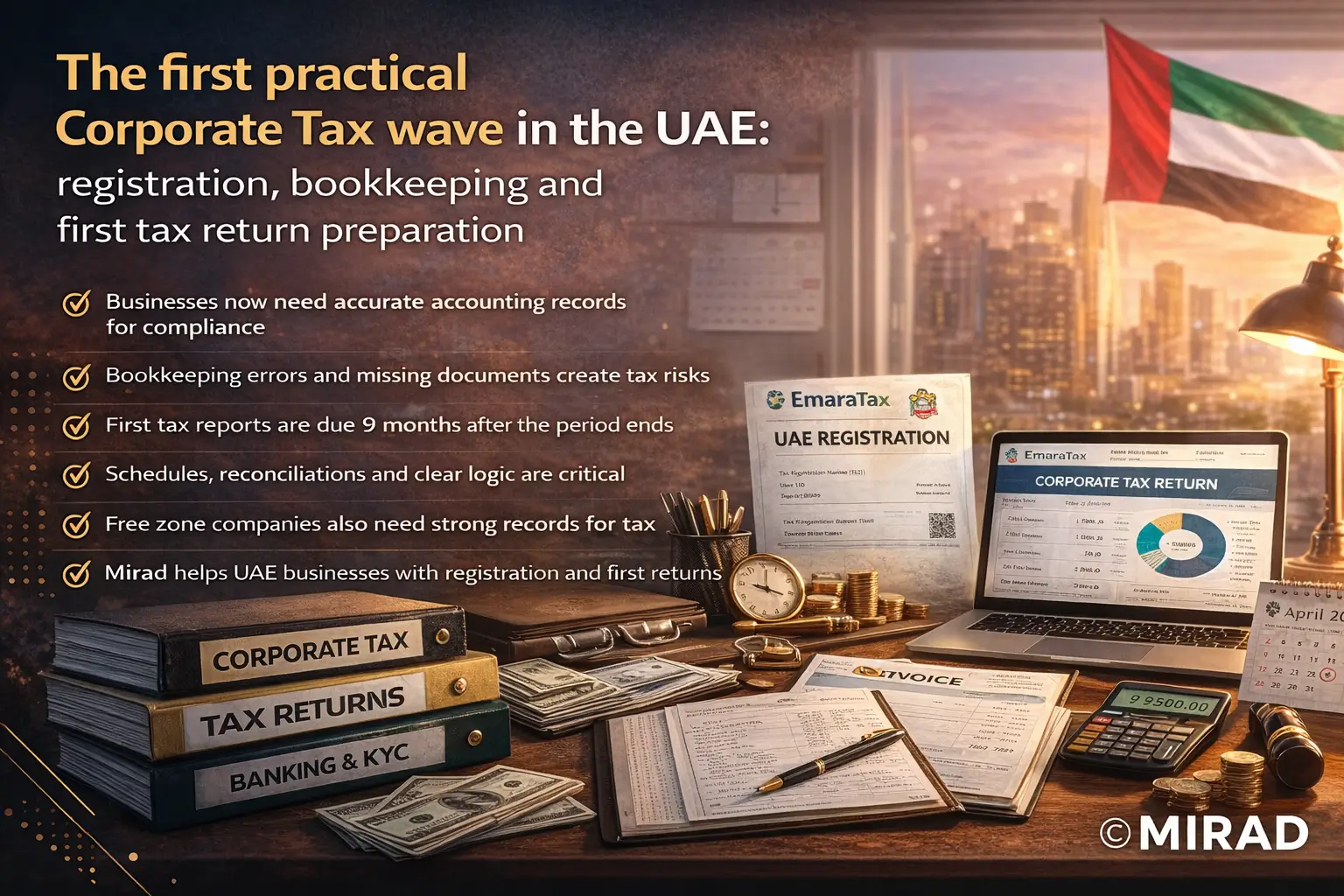
  • Corporate Tax returns and payment are generally due within nine months after the end of the tax period, while records must generally be retained for at least seven years.
  • Late registration may trigger an AED 10,000 penalty, but eligible taxpayers can receive an automatic waiver or refund if the first return is filed within seven months after the end of the first tax period.
  • Large multinational groups may also fall within the UAE Domestic Minimum Top-up Tax rules for financial years starting on or after 1 January 2025.

In this guide


When UAE Corporate Tax applies

The Corporate Tax Law applies to tax periods commencing on or after 1 June 2023. This distinction matters because companies use different financial years. A company whose financial year began on 1 June 2023 entered the regime from that date, while a company with a calendar financial year generally entered its first Corporate Tax period on 1 January 2024.

The tax period is usually the financial year used for preparing the company’s financial statements. The first period can be longer or shorter in specific circumstances, but the period must normally remain within the limits permitted by the Corporate Tax rules.

Who is subject to UAE Corporate Tax?

UAE resident juridical persons

Most companies and other juridical persons incorporated or otherwise established under UAE mainland or free zone legislation are Resident Persons for Corporate Tax purposes. A foreign-incorporated entity may also be treated as resident when it is effectively managed and controlled in the UAE.

Natural persons, freelancers and sole establishments

A natural person is generally subject to Corporate Tax when they conduct a Business or Business Activity in the UAE and the total turnover from those activities exceeds AED 1 million during the calendar year. The test applies to business turnover, not total personal income.

  • Wages and employment income are not treated as a Business or Business Activity for this purpose.
  • Personal Investment Income is excluded when the relevant conditions are met.
  • Real Estate Investment Income is excluded when it is derived in a personal capacity and the applicable conditions are met.
  • Once business turnover exceeds AED 1 million, the person generally registers by 31 March of the following calendar year.

Non-resident persons

A non-resident juridical person can come within scope where it has a Permanent Establishment in the UAE, derives UAE-sourced income in circumstances covered by the law, or has a nexus in the UAE. The registration, taxable-income and filing analysis depends on the specific connection with the UAE.

Exempt Persons

Not every legal entity is taxable under the standard rules. The Corporate Tax Law recognises categories of Exempt Persons, subject to detailed conditions and, for some categories, an application or listing requirement.

  • UAE Government Entities and certain Government Controlled Entities.
  • Certain businesses engaged in extractive or non-extractive natural-resource activities where the legal conditions are met.
  • Qualifying Public Benefit Entities.
  • Qualifying Investment Funds and certain other investment structures that satisfy the applicable conditions.
  • Certain public or private pension and social-security funds.
  • Certain juridical persons wholly owned and controlled by qualifying exempt entities and carrying out permitted activities.

Important: exempt status should never be assumed from the company’s ownership, industry or non-profit purpose alone. The specific conditions and registration or annual-declaration obligations must be checked.


UAE Corporate Tax rates in 2026

Taxpayer or income categoryGeneral treatmentImportant point
Most taxable persons0% on taxable income up to AED 375,000; 9% on taxable income above AED 375,000The threshold applies to taxable income, not turnover.
Qualifying Free Zone Person0% on Qualifying Income; 9% on taxable income that is not Qualifying IncomeThe company must satisfy all QFZP conditions and maintain evidence.
Large multinational groups within UAE DMTTTop-up tax may apply to bring the effective tax rate to the required minimumApplies to in-scope MNE groups with annual global revenue of at least EUR 750 million in at least two of the previous four financial years.

The AED 375,000 band is available once per taxable person or Tax Group, not separately for each shareholder, branch or company included in the same Tax Group. A company with revenue above AED 375,000 does not automatically pay 9%; the rate is applied to taxable income after the permitted adjustments.

Domestic Minimum Top-up Tax

The UAE Domestic Minimum Top-up Tax applies for financial years starting on or after 1 January 2025 to UAE constituent entities of multinational enterprise groups meeting the EUR 750 million global-revenue test in at least two of the four immediately preceding financial years. It is a separate Pillar Two analysis and is generally irrelevant to ordinary small and medium-sized businesses.


Corporate Tax registration deadlines

VAT registration and Corporate Tax registration are separate. A company that already has a VAT TRN still needs a Corporate Tax registration number where it is required to register.

PersonGeneral registration timelinePractical position in 2026
UAE juridical person incorporated on or after 1 March 2024Generally within three months from incorporation, establishment or recognitionRegister promptly through EmaraTax and do not wait for the first return.
UAE juridical person existing before 1 March 2024The deadline depended on the month in which the first licence was issuedThose historical deadlines have passed; an unregistered entity should regularise its position immediately.
Non-resident person with a Permanent EstablishmentGenerally within six months from the date the Permanent Establishment existsThe date on which the PE arose must be documented.
Non-resident person with a nexus in the UAEGenerally within three months from establishing the nexusProperty and other UAE connections require case-specific review.
Natural person exceeding AED 1 million of business turnoverBy 31 March of the calendar year following the year in which the threshold was exceededThe calculation excludes wages, Personal Investment Income and qualifying Real Estate Investment Income.

Registration applications are submitted through EmaraTax. See the FTA Corporate Tax registration service and the FTA clarification on registration timelines.


How taxable income is calculated

The calculation normally begins with accounting income for the tax period, prepared using the applicable accounting standards. The accounting result is then adjusted under the Corporate Tax Law to arrive at taxable income.

StageWhat happens
Accounting incomeStart with the profit or loss shown in the financial statements.
Exempt incomeRemove qualifying dividends, participation income or other exempt amounts where the legal conditions are met.
Non-deductible expenditureAdd back fines, prohibited expenses, the non-deductible portion of entertainment and other restricted items.
Related parties and connected personsAdjust transactions that are not consistent with the arm’s-length standard or the applicable payment rules.
Interest and other limitationsApply any relevant deduction restrictions and elections.
Tax losses and reliefsUse eligible tax losses or reliefs subject to their conditions and limitations.
Taxable incomeApply the appropriate standard, free zone or other applicable tax treatment.

Applicable accounting standards

IFRS is the principal accounting framework used for Corporate Tax. An eligible taxpayer with revenue not exceeding AED 50 million may use IFRS for SMEs. A cash basis may be available in limited circumstances, generally where revenue does not exceed AED 3 million, subject to the applicable rules and any required FTA approval for exceptional cases.

Business deductions

An expense is not deductible merely because it appears in the accounts. It must be incurred wholly and exclusively for the purposes of the taxable person’s business, be properly supported, and not fall within a prohibition or restriction. Private expenses, capital items, related-party payments and mixed-purpose expenditure require careful treatment.

  • Salaries and employee costs supported by contracts and payroll records.
  • Commercial rent and operating expenses connected with the business.
  • Professional, software, marketing and logistics costs with a genuine business purpose.
  • Depreciation and finance costs subject to the applicable accounting and tax rules.
  • Entertainment expenditure, of which only the permitted portion may be deducted.
  • Administrative fines and penalties, which are generally not deductible.

Small Business Relief in 2026

An eligible Resident Person may elect for Small Business Relief where revenue does not exceed AED 3 million in the relevant tax period and in all previous tax periods beginning on or after 1 June 2023. The relief is available only for tax periods ending on or before 31 December 2026.

  • The AED 3 million test is based on revenue, not taxable profit.
  • The threshold includes AED 3 million; the condition is that revenue does not exceed the threshold.
  • If revenue exceeded AED 3 million in an earlier relevant tax period, the business cannot use the relief in a later period.
  • The election is made in the Corporate Tax Return.
  • A Qualifying Free Zone Person cannot elect for Small Business Relief.
  • Members of certain multinational enterprise groups are excluded.
  • The company must still register, file, maintain accounting records and support its revenue calculation.

Electing for the relief can affect the use or creation of tax losses, interest deductions and other tax attributes. The business should compare the immediate benefit with its expected position in later periods before making the election.


Free zone companies and the 0% Corporate Tax regime

A Free Zone Person is within the Corporate Tax regime and must generally register and file. The 0% rate is available only to a Qualifying Free Zone Person and only for Qualifying Income. The location of the licence by itself does not establish the tax result.

Core conditions for a Qualifying Free Zone Person

  • Maintain adequate substance in the UAE.
  • Derive Qualifying Income under the current Cabinet and Ministerial Decisions.
  • Comply with transfer-pricing rules and documentation requirements.
  • Meet the de minimis requirement for non-qualifying revenue.
  • Prepare and maintain audited financial statements.
  • Not elect to be subject to the standard Corporate Tax regime.
  • Comply with any additional procedures issued by the FTA for the relevant activity.

Qualifying Income and the de minimis test

The treatment depends on the type of activity, the counterparty, the location from which the activity is carried on, whether the activity is qualifying or excluded, and whether the income satisfies the relevant rules. Non-qualifying revenue must remain within the de minimis limit, generally the lower of AED 5 million and 5% of total revenue.

Risk of losing the regime: failure to satisfy the QFZP conditions can cause the entity to cease being a Qualifying Free Zone Person from the beginning of the relevant tax period and for the subsequent periods prescribed by law. This is more serious than applying 9% to one isolated transaction.

2026 procedures for certain distributors in Designated Zones

FTA Decision No. 6 of 2026 introduced additional compliance procedures for a QFZP engaged in distribution of goods or materials in or from a Designated Zone. It applies to tax periods starting on or after 1 January 2026.

  • Obtain an agreed-upon procedures report from an independent external auditor licensed in the UAE.
  • Support that relevant customers are resellers or process or alter the goods for sale or resale.
  • Where the QFZP imports the goods, support importation through a Designated Zone.
  • Retain customer licences, written confirmations, contracts, invoices, purchase orders, customs and shipping documents, and internal inventory or logistics records.
  • Submit the report within the timeline specified by the Decision, generally no later than 30 days after the Corporate Tax return filing deadline.

Tax Groups, group reliefs and tax losses

Corporate Tax Group

Eligible UAE resident juridical persons can apply to form a Tax Group and be treated as a single taxable person. The parent company must generally hold at least 95% of the share capital, voting rights and rights to profits and net assets of each subsidiary, directly or indirectly.

  • Members must generally be UAE Resident juridical persons.
  • The parent and subsidiaries must use the same financial year and accounting standards.
  • An Exempt Person and a Qualifying Free Zone Person cannot normally join the Tax Group.
  • The group prepares consolidated tax information and receives one AED 375,000 0% band.
  • Transactions between members are generally eliminated subject to anti-avoidance and member-exit rules.

Tax losses

Eligible tax losses can generally be carried forward and used against future taxable income subject to the legal conditions and the applicable utilisation limit. Separate rules govern pre-grouping losses, transfers of losses between qualifying entities and continuity of ownership or business.


Transfer pricing and related parties

The arm’s-length principle applies to transactions and arrangements between Related Parties and Connected Persons. This can affect management fees, shareholder or director remuneration, intercompany loans, intellectual-property charges, shared employees, purchases, sales and services within a group.

  • Identify Related Parties and Connected Persons before preparing the return.
  • Maintain agreements and evidence of the services, goods, financing or rights supplied.
  • Use an appropriate transfer-pricing method and support the pricing with available market or benchmarking evidence.
  • Complete the related-party disclosures in the Corporate Tax Return where required.
  • Prepare a Master File and Local File where the applicable revenue or multinational-group thresholds are met.

The absence of an invoice or written agreement does not remove a related-party transaction from the Corporate Tax analysis. Conversely, an invoice alone does not prove that the price is arm’s length or that the expense is deductible.


When are audited financial statements required?

For tax periods beginning on or after 1 January 2025, Ministerial Decision No. 84 of 2025 requires audited financial statements for a taxable person that is not a Tax Group and has revenue exceeding AED 50 million during the relevant tax period, and for every Qualifying Free Zone Person. Tax Groups are subject to separate audited special-purpose financial-statement requirements.

A free zone authority, licensing body, bank, investor, shareholder agreement or regulator may require an audit even when the Corporate Tax revenue threshold is not met. The company must therefore check both tax and non-tax requirements.

  • The trial balance reconciles to the financial statements and Corporate Tax return.
  • Bank, customer, supplier, payroll, loan and related-party balances are reconciled.
  • Revenue, expenses and material journal entries have source documents and explanations.
  • Fixed assets, inventory, equity, leases and financing have complete schedules.
  • Free zone income streams and allocated costs are separately identifiable.
  • The auditor can trace samples from the financial statements to contracts, invoices and payment evidence.

Corporate Tax returns, payment and record retention

Return and payment deadline

The Corporate Tax Return and any tax payable are generally due within nine months after the end of the tax period. For example, a company with a financial year ending on 31 December 2025 would ordinarily file and pay by 30 September 2026.

Record retention

Taxable persons must generally retain records and documents for at least seven years after the end of the tax period to which they relate. The records should support accounting income, taxable income, exemptions, deductions, reliefs, tax losses, transactions with related parties and all figures reported to the FTA.

Corporate Tax deregistration

When a taxable person ceases business or is liquidated, the Corporate Tax deregistration application is generally submitted within three months from the relevant cessation or dissolution event. Final returns, payments and requested documents must still be completed. A backlog in accounting should be reconstructed promptly, but the company should not delay the deregistration application merely while waiting for every accounting issue to be resolved.


Penalties and the late-registration waiver

Failure to submit the Corporate Tax registration application within the prescribed timeline may result in an administrative penalty of AED 10,000. Other penalties can apply for late returns, late payment, incorrect returns, failure to keep records or failure to provide information requested by the FTA.

Late-registration penalty waiver

The FTA waiver initiative can cancel or refund the AED 10,000 late-registration penalty where the taxable person completes registration and submits its first Corporate Tax Return within seven months from the end of the first tax period. For relevant Exempt Persons, the annual declaration must be submitted within seven months from the end of the first financial year.

  • The waiver applies only to the first tax period or first financial year.
  • It can apply whether the penalty is unpaid or has already been paid.
  • Where the conditions are met, the waiver or account credit is generally applied automatically.
  • A person relying on the initiative should not wait for the ordinary nine-month filing deadline.

A practical Corporate Tax compliance process


How MIRAD can support your company

MIRAD can review the company’s legal and tax status, organise the accounting evidence and manage the Corporate Tax process from registration through filing. The exact scope should be agreed after reviewing the financial year, licences, free zone status, transaction volume, related parties and historical compliance.

  • Corporate Tax registration and review of registration deadlines.
  • Accounting cleanup and reconstruction of historical periods.
  • Preparation of financial statements and Corporate Tax reconciliations.
  • Small Business Relief eligibility assessment.
  • QFZP and Qualifying Income analysis for free zone businesses.
  • Related-party mapping and transfer-pricing documentation.
  • Tax Group and group-relief assessment.
  • Corporate Tax return preparation and filing support.
  • Audit-readiness schedules and coordination with an independent UAE-licensed auditor where required.
  • Support with FTA queries, voluntary disclosures and deregistration.

Indicative MIRAD service fees

ServiceIndicative feeNotes
Corporate Tax registrationFrom AED 1,000One-time; depends on status and urgency.
Corporate Tax return preparationFrom AED 2,000Depends on accounting quality, transaction volume and complexity.
Tax position or structuring assessmentFrom AED 10,000Scope agreed after an initial review.
Corporate Tax deregistration supportFrom AED 2,000Final filings and accounting recovery are priced separately where needed.

Fees are indicative, exclude 5% VAT on MIRAD’s service fee, and may change after review of the company’s records and obligations.

Need to verify your UAE Corporate Tax position?

MIRAD can review registration, accounting, free zone treatment, reliefs and filing deadlines, then provide a practical compliance plan.

Request a Corporate Tax review

UAE Corporate Tax: frequently asked questions

Does every UAE company pay 9% Corporate Tax?

Must a company register when it expects no tax to be payable?

Is the AED 375,000 threshold based on revenue?

When is a freelancer or individual subject to Corporate Tax?

Does a free zone company automatically qualify for 0%?

What is the Small Business Relief threshold?

When is the Corporate Tax Return due?

What is the penalty for late Corporate Tax registration?

When are audited financial statements required?

Can related companies combine their Corporate Tax position?

How long must Corporate Tax records be kept?

Can a company deregister if its bookkeeping is incomplete?


Official sources used for this guide

  • Federal Tax Authority — Corporate Tax portal
  • Federal Tax Authority — Corporate Tax registration
  • FTA — Registration timelines for taxable persons
  • FTA — Basis of taxation for natural persons
  • FTA — Small Business Relief
  • FTA — Free Zone Persons guide
  • FTA — Current Corporate Tax legislation and decisions
  • FTA — Late-registration penalty waiver
  • FTA — Filing and record-retention guidance
  • Ministry of Finance — UAE Domestic Minimum Top-up Tax

Disclaimer: This guide is for general information only and does not constitute legal, tax, accounting or audit advice for a specific person. UAE tax legislation, decisions, procedures and free zone rules can change, and their application depends on the facts. Verify the current official requirements and obtain advice from appropriately qualified professionals before acting.

What you need to know to get Emirates ID?

Leave your details and get a guide as a gift to avoid mistakes

Guide illustration
Article contents

    Related articles